


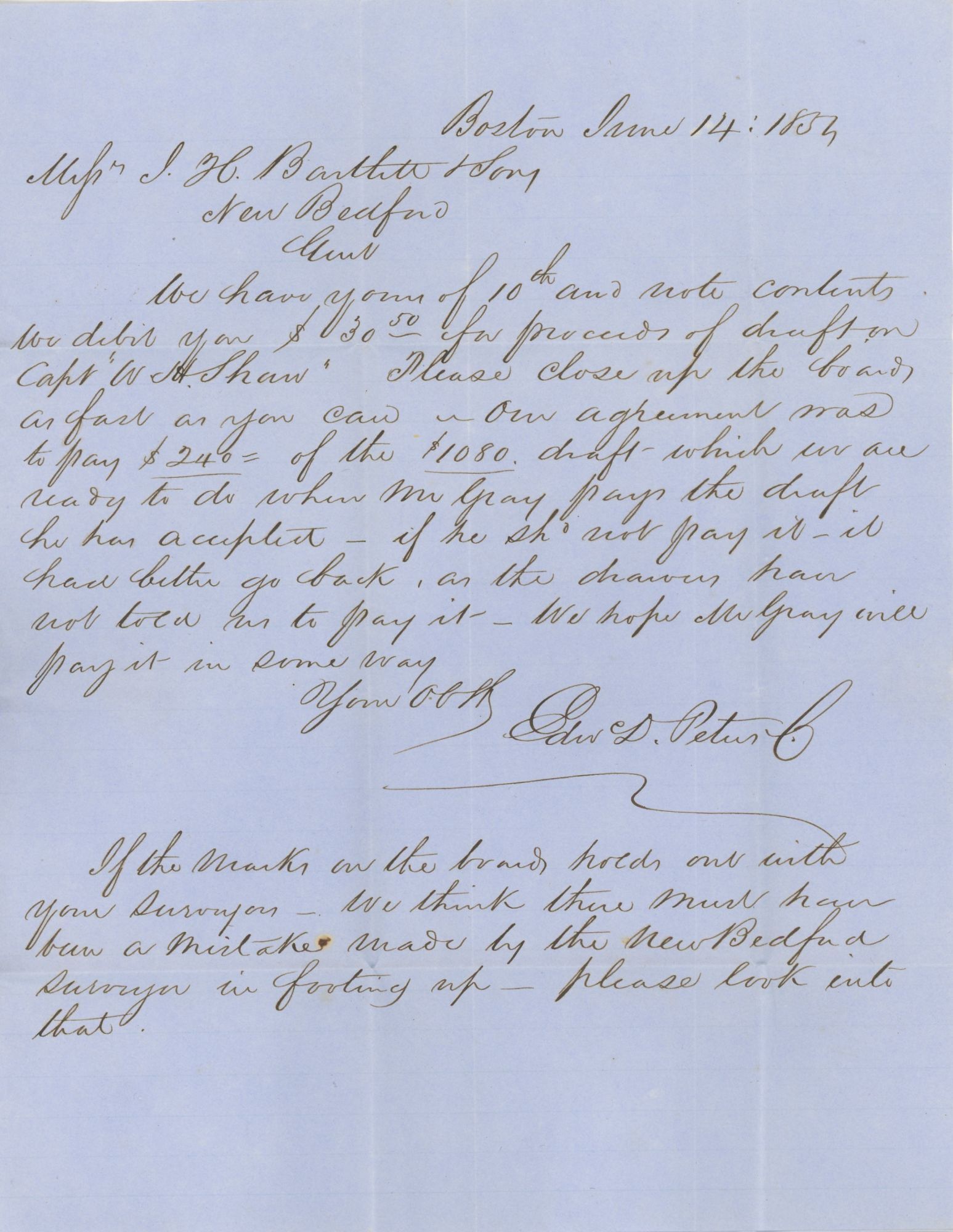


Collection of Letters Mainly to New Bedford, Massachusetts Whalers I.H. Bartlett & Sons, 1830s–1850s.
Massachusetts, New York, Maine, Pennsylvania, and others: 1832–1855. Fifty letters with four empty envelopes or covers. Forty-four letters addressed to I.H. Bartlett & Sons: two from the 1830s, eight from the 1840s, and thirty-four from the 1850s. With five letters addressed to Capt. John C. Blanchard (1838, 1839, 1844, and 1849) and one to Cumston & Hatch (N.d.). Overall excellent to Near Fine. Item #List3333
Ivory Hovey Bartlett (1794–1871) was a merchant and whale oil seller based in New Bedford, Massachusetts. Bartlett moved to New Bedford from Plymouth in 1819, first dealing in grain and later transitioning to general merchandise and whaling.[1] Whale oil and spermaceti were widely used in lamps and as lubricant, and whalebone (baleen) was used for structure in items like umbrellas and corsets. In the nineteenth century, whaling was the basis of New Bedford’s economy—supporting shipbuilding, refineries, toolworks, and more—making it the wealthiest city in North America at the peak of the industry in the midcentury. Whaling declined in the 1860s with the rise of petroleum, which could be both used as a lubricant and distilled into kerosene for lighting.
Offered here is a collection of letters mainly to Bartlett’s company, I.H. Bartlett & Sons, with five to Captain John C. Blanchard of Searsport, Maine, and one to Cumston & Hatch. The latter is unknown; Blanchard was in the cotton and sugar trades, sailing between the US, Europe, and West Indies.
Letters to Bartlett are mainly from other mercantile firms; they pay bills, make purchases, discuss oil prices, and occasionally complain. For instance, Robert Robinson of Portland, Maine, writes:
“I have just got 4 Casks of my oil 3 of the last and 1 of the invoice of 30th ult. I cannot understand why my oil should be keep back in this way. Hyde had seven casks by yesterdays Boat the same boat which mine came by it seem’s as if the fates where against this Oil as yesterday boat did not arrive untill late yesterday afternoon and this mornings boat has arrived without the balance there must be something [w]rong somewhere [...]. I must say I think such neglect should be made known but perhaps it would be better to suffer for fear of the future. I shall not be able to get off any oil untill tomorrow as the oil was not out of the boat untill this morning. it is not thirteen days since that one cask left New Bedford [...]”. (October 13, 1852)
Most of Bartlett’s customers buy whale oil (though beef, molasses, and coal are also discussed), but some are interested in whalebone; as are Wright Bros & Co, a Philadelphian umbrella manufacturer, who write to complain about market speculation:
“The fact appears to us that speculation and the [?] calculation of holders put the price + kept it so high, that it considerably lessened consumption – so much so of late that some have been disposed to slide it off below New Bedford rates very quietly.” (October 23, 1852)
The letters to all parties are generally all business, except for two of the five to John Blanchard: one from his wife Caroline Houston, and one from fellow Searsport captain David Nickels, Jr. (1823–1888), who writes from Bangor:
“I see by to day’s Mercantile gazette that you are in trouble I can sympathize with you God knows I have had a good share of it since I left the land of Gospel light and liberty as the good people say in their prayers I have been in this place fifteen days you doubtless knew I was chartered by Capt Pendleton to go from Leith to Bangor for a cargo of slates and from here to Boston I sailed from Leith on the 27th of November last for this place I got as far as the Orkney Islands on the 30th of November the wind blowing heavy from the westward and having a pilot belonging to the Orkneys on board I concluded to take the harbour of Longhope and lay till a shift of wind or till it moderated [...] [in] spite of all our endeavouring we were driven on shore broke the keel out of her filled as high as the lower deck which was on the 3d of December and on the 22d of March we left the Orkney Islands after having been near four months there When I got here I found the man who was to freight the Barque from here to Boston had neglected to place funds in the hands of the slate agent of this place consequently he refuses to put slates on board of the vessel till he receives funds from Boston [...]”. (May 13, 1849)
Overall a look at the dealings of maritime merchants in the mid-nineteenth century, particularly in the critical east coast whaling industry.
[1] “Death of a Well-Known Merchant,” The Standard-Times, February 6, 1871, 2.
Price: $3,750.00